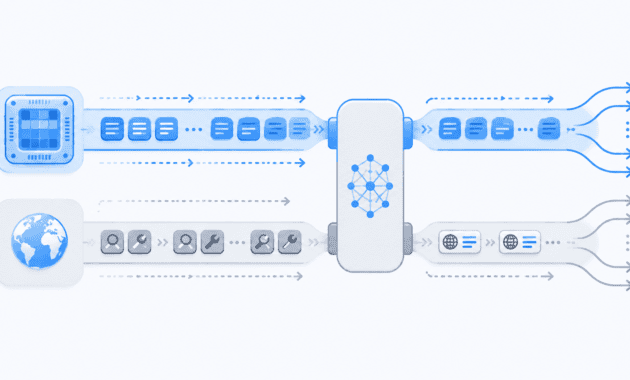
Training an LLM to use tools is slow. That’s the short version of a problem Google engineers have been wrestling with. When a model-in-training has to pause, call an API, run some code, or wait for a web search to return, the expensive TPUs sitting behind it go idle. Those accelerators cost real money. Google’s answer is Tunix, a JAX-native post-training library that keeps the chips fed while the agent waits.
The Bottleneck Is the Environment, Not the Model
Standard reinforcement learning for chatbots is relatively straightforward. The model generates a response, gets a reward, and updates its weights. But agentic RL is different. The model doesn’t just produce text. It reasons across multiple steps, calls external tools, and interacts with dynamic environments. Each of those environment calls introduces latency—network I/O, database queries, code execution. During that time, the TPU has nothing to do.
Google’s engineers measured the problem directly. In a typical multi-turn training loop, the accelerator utilization can drop by 40% or more during environment steps. That waste compounds over thousands of training iterations. The solution isn’t to make the environment faster. It’s to restructure the training pipeline so the TPU never has to wait.
How Tunix Keeps TPUs Busy
Tunix attacks the idle-TPU problem on two fronts. First, it uses asynchronous rollouts. Instead of the TPU generating a token, then waiting for the environment to respond, then generating the next token, Tunix decouples the two processes. The rollout engine runs at high concurrency, managing multiple agent-environment interactions simultaneously using Python’s asyncio. While one agent waits for a tool call to complete, another agent is actively generating tokens on the TPU. The RolloutOrchestrator manages this parallelism with a configurable max_concurrency parameter.
Second, Tunix uses what the team calls barrier-free pipelining. In many training systems, the trainer waits for all trajectories in a batch to complete before processing. That creates a synchronization barrier that amplifies latency. Tunix uses a dynamic producer-consumer architecture. As soon as any trajectory finishes, it gets streamed to the trainer immediately. The trainer never stalls waiting for the slowest trajectory.
Observability Without the Overhead
Debugging performance in these systems is notoriously hard. Standard profilers like XProf give deep operator-level traces, but they’re expensive to run continuously. Google’s team built continuous, lightweight instrumentation directly into Tunix that tracks domain-specific RL metrics—rollout throughput, environment latency, pipeline stall time. Developers can correlate these high-level loop metrics with TPU timelines to find bottlenecks without running a separate profiling session.
This matters because the bottlenecks in agentic RL are often not where you’d expect. A slow tool call might not matter if the pipeline can hide the latency. But a subtle bug in the trajectory batching code could cause the entire pipeline to stall. Tunix’s instrumentation makes those problems visible.
LoRA Support and Memory Efficiency
Training large models with full parameter updates is expensive. Tunix supports LoRA (Low-Rank Adaptation) natively, which reduces the memory footprint significantly. In RL workflows, this allows the Actor and Reference models to share a single frozen base model. That cuts the HBM requirement roughly in half. The library also supports QLoRA for even more aggressive memory compression.
The performance documentation describes how Tunix handles weight synchronization between the Actor and Rollout engines. With LoRA, only the lightweight adapter weights need to be transferred, not the full model. That speeds up the sync process and reduces network bandwidth requirements in multi-host setups.
Practical Example: Gemma 2B with GRPO
Google published a demo script that shows how to train a Gemma 2 2B-IT model on the GSM8K math reasoning benchmark using Group Relative Policy Optimization (GRPO). The script runs on a v5e-8 TPU configuration. It uses a mesh of (2, 4) devices with FSDP and tensor parallelism. The generation parameters include a temperature of 0.9, top-p of 1.0, and top-k of 50—deliberately high diversity to explore the solution space.
The script demonstrates the full pipeline: data loading, model initialization with LoRA, rollout configuration, and the training loop. It’s a concrete example of how the abstractions in Tunix—the ToolAgent, ToolEnvironment, and RolloutOrchestrator—fit together in practice.
What This Means
Three things stand out about Tunix.
First, the bottleneck problem is real and getting worse. As models get better at multi-step reasoning, they’ll make more tool calls. Each call introduces latency. The industry is moving toward agents that browse the web, run code, and query databases. If the training infrastructure can’t keep up, progress stalls. Tunix addresses that directly.
Second, the architecture is a template for the industry. The combination of asynchronous rollouts and barrier-free pipelining isn’t specific to Google’s TPUs. Any training system that deals with variable-latency environment interactions could benefit from the same approach. Expect to see similar patterns in other training frameworks.
Third, observability is the hidden enabler. You can’t fix what you can’t measure. Google’s decision to build continuous lightweight instrumentation into Tunix, rather than relying on external profiling tools, signals that they expect performance debugging to be a first-class concern. That’s the right call for a system this complex.
Tunix is open source and available on GitHub. The documentation covers installation, supported algorithms (PPO, GRPO, DAPO, and others), and model support for Gemma, Llama, and Qwen families. For teams building agentic systems, it’s worth a close look.
Frequently Asked Questions
What hardware does Tunix support?
Tunix is designed for Google TPUs, specifically the v5e and newer generations. It uses JAX for computation and integrates with vLLM and SGLang-JAX for inference. The library can scale to thousands of devices using Pathways for multi-host distributed training.
Does Tunix support models other than Gemma?
Yes. Tunix supports the Gemma, Llama, and Qwen model families. The library provides a model abstraction layer that makes it possible to add new models. The documentation includes instructions for integrating custom models.
How does Tunix compare to other RL training frameworks?
Tunix is differentiated by its focus on agentic RL and its native handling of the environment-latency problem. Most RL frameworks assume the environment is fast or synchronous. Tunix is built from the ground up for the multi-turn, tool-using case. Its asynchronous rollout engine and barrier-free pipelining are unique features not found in standard RL libraries.