
In the last week of July 2026, an open-weight model from Chinese startup Moonshot AI started appearing in developer chat servers and on Twitter timelines. Kimi K3 was topping a key benchmark for frontend design, and people could not stop posting screenshots. Some called it a Claude killer. Others warned the enthusiasm was racing ahead of what the model could actually deliver. The result was a story that moved from a quiet release to one of the loudest AI discussions of the month.
Kimi K3 Topped LMArena’s Frontend Design Leaderboard
LMArena is a crowdsourced comparison site where developers vote on which model produces the better answer to a given prompt, without knowing which model is which. It’s not a perfect test, but it influences what developers try next. On July 25, AI LABS, a YouTube channel run by the software company autometa.dev, noted that Kimi K3 had just grabbed the number one spot for frontend design tasks. The video title claimed the model was “a 10x better designer” with the right prompting technique.
That ranking shift caught attention fast. Claude models, especially the newly released Opus 5, had been the go-to for many engineers building dashboards, landing pages and data visualisations with AI. A new name at the top of that particular leaderboard was enough to start a round of side-by-side tests.
A Head-to-Head Beating of Claude Opus 5
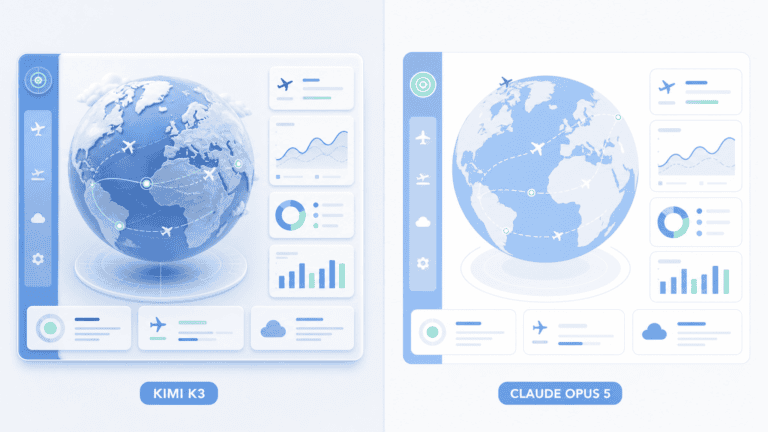
The first wave of comparisons did not just talk about Elo scores. They showed screenshots. One of the most shared videos came from Codedigipt, a YouTube channel focused on coding and AI tools. The host gave both Kimi K3 Max and Claude Opus 5 Max the same prompt: build a 3D globe flight radar dashboard. Then they asked ChatGPT to rate both outputs purely as an observer.
The results were lopsided. Kimi K3’s dashboard scored 9.3 out of 10. Opus 5 got 8.4. The host highlighted specific differences: Kimi’s globe had sharper textures and a more realistic atmospheric glow; the cloud layer showed better depth; the overall composition felt more polished. Opus 5’s version looked flatter and less convincing as a real-world control panel.
“At a glance, the Kimi K3 output is far better than the Opus 5 Max version,” Codedigipt says in the video. They also noted a pricing gap. Anthropic’s Opus 5 costs $5.25 per million input and output tokens. Kimi K3, the host says, is “less than the Opus 5 Max”, though an exact figure wasn’t given. For developers who run these models repeatedly to generate or refine UI components, that price difference compounds quickly.
The Skill That Removes ‘AI Slop’ from Designs
Not everyone who tried Kimi K3 got those polished results straight away. AI LABS’ video pointed to a specific technique that unlocked the jump in quality. They called it a “skill” that strips out what many developers call AI slop: overly busy designs, generic rounded corners on everything, too many glowing buttons. Without that skill, K3’s raw output could still look cluttered. With it, the model produced the clean, realistic interfaces that started spreading on social media.
The exact prompt method wasn’t described in detail in the public materials, but the implication is clear. Prompt engineering matters a lot here. The people getting 10x improvements were not just asking for “a modern dashboard”. They were giving structured instructions that constrained the model toward real-world proportions and restrained colour use. That explains why some early testers saw average results while others posted the screenshots that made K3 go viral.
Pricing Shifts the Value Equation
Claude Opus 5 is Anthropic’s flagship reasoning and coding model. It ships with safety guardrails that, according to the company’s announcement, are less restrictive than those on its Fable 5 model for certain cybersecurity tasks. Codedigipt’s video notes that Opus 5 can now find vulnerabilities in source code, while binary-based scanning remains blocked. That’s not relevant for frontend design, but it shows that Opus 5 is positioned as a high-end workhorse, not a cheap option.
Kimi K3 being an open-weight release changes the calculation. Teams can host it themselves, avoid per-token API costs for internal work, and fine-tune it if they want. Even using an API, the lower listed price makes it attractive for design-heavy pipelines where a model might be called dozens of times per session. The combination of better design output in at least some head-to-head tests and lower cost pushed developers to declare K3 the smarter pick for UI generation, regardless of how Opus 5 performs on general reasoning benchmarks.
Sceptics Warn This Is Just One Benchmark Victory
Cole Medin, a creator known for pragmatic AI agent testing, posted a video titled “Is Kimi K3 Really That Good?! (Don’t Just Believe The Hype)”. The title alone captures a sentiment that built up as the viral posts peaked. One benchmark topping does not make a model the best at everything. LMArena frontend design is a narrow slice. K3’s coding speed got mentions in other threads as a possible weak point. AI LABS’ video promised to explain “why Kimi Code is slow” right in its description.
So while the design quality turn heads, developers who need fast auto-complete or long-context refactoring might still prefer a model that trades some visual polish for snappier response times. Open-weight also means the model is larger and demands more VRAM for local inference. That can limit its accessibility for individual developers on consumer hardware. The scepticism does not kill the story, but it frames it: K3 is very good at one thing, and that thing happens to be highly visible and easy to screenshot.
Kimi K3: A New Choice for Design-Heavy Workflows
Moonshot AI’s Kimi K3 broke into the conversation not through a press release but through direct developer comparisons. It beat a flagship Anthropic model on a specific but valuable task, undercut it on price, and revealed how much the right prompting technique can unlock. For frontend design work, it is now the open-weight model to test first. The hype might overshoot, but the side-by-side outputs speak for themselves.
FAQ
What is Kimi K3?
Kimi K3 is an open-weight large language model from Moonshot AI, a Chinese startup. It gained attention for topping the LMArena frontend design leaderboard and producing UI outputs that testers rated higher than those from Claude Opus 5 in direct comparisons.
How does Kimi K3 compare to Claude Opus 5?
In side-by-side tests with identical design prompts, Kimi K3 Max delivered sharper textures, more realistic lighting, and a higher overall rating from a third-party judge than Claude Opus 5 Max. It is also reportedly cheaper per token, though exact API pricing details are still being clarified.
Is Kimi K3 free to use?
As an open-weight model, Kimi K3 can be downloaded and run locally if you have the hardware to support it, eliminating per-call API fees. API access from Moonshot AI is available at a lower cost than Anthropic’s Opus 5, according to early testers, but is not free.