A Side-by-Side Test Challenges the Price of Premium AI
The conversation around large language models has changed. It is no longer just about which model wins on some complicated benchmark. Developers now ask a simpler question: which model deserves which job, and how much should I actually pay for it?
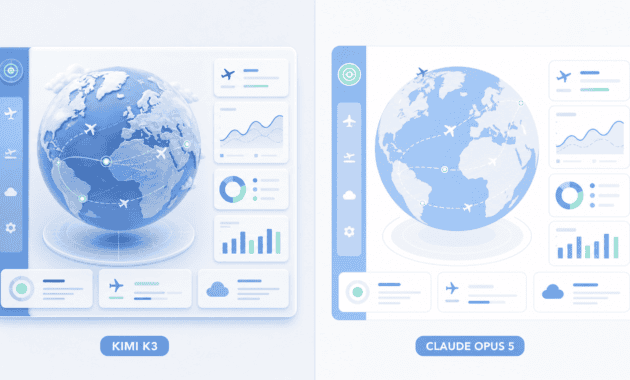
A recent hands-on test captured that shift well. One tester built the same 3D globe flight radar dashboard using both Kimi K3 and Claude Opus 5 Max. He then fed both outputs into ChatGPT and asked for an unbiased side-by-side rating. Kimi K3 scored 9.3 out of 10. Claude Opus 5 Max scored 8.4. The full walkthrough is in a YouTube comparison.
That gap is not huge, but it matters once you factor in the price tags on each model. It also adds to a growing pile of evidence that open-weight systems are catching up with proprietary ones on creative and front-end coding work.
The 3D Globe Dashboard: How the Two Models Stacked Up
The tester used one prompt to generate an interactive globe dashboard: a realistic globe with atmospheric glow, cloud layers, flight paths, and a side data panel. Kimi K3 produced the sharper, more polished result. The texture detail stood out. The atmospheric effect looked more natural. The whole thing felt more premium. Claude Opus 5 Max built a working dashboard too, but the textures were flatter and the depth wasn’t there.
ChatGPT, acting as blind judge, called out specifics: image one, the Kimi K3 output, had sharper art texture, a subtle and believable atmospheric glow, and good depth in the cloud layer. The Claude Opus 5 output got notes about flatter visuals and fewer standout details. That kind of structured comparison lines up with what other builders are starting to report across coding and UI generation tests.
Worth noting: the tester had already run this same prompt on GLM 5.2 and Tencent HY3. Kimi K3 beat those too. So this wasn’t a one-off.
Pricing and the Real-World Cost Gap
Output quality is only half the story. The other half is cost. In the video, the tester points out that Claude Opus 5 prices input and output at $5.25 per million tokens, while Kimi K3 runs cheaper. Independent sources back up those numbers.
A Reddit discussion broke the pricing down further. Kimi K3’s official API rates sit around $3 per million input tokens and $15 per million output tokens. Claude’s higher tier, Fable 5, runs roughly $10 per million input and $50 per million output. Opus 5 sits in between, but it’s still noticeably pricier than the Moonshot AI model.
What sharpens the comparison is the Deep SW benchmark the tester cited. Kimi K3 scored 69%. Opus 5 scored 74%. Fable 5, the pricier option, scored 70%. Now look at average cost per task: Kimi K3 came in around $4.65, Opus 5 at $11.84, and Fable 5 at $21.63. A model that lands within a few points of the leader while costing less than half is hard to wave off, especially at a few thousand tasks a month.
When Claude Still Has the Edge
This isn’t a clean sweep for Kimi K3. The same Reddit thread and a detailed AIWerse article both point out where Claude’s models, Opus 5 and Fable 5 included, still hold ground.
Complex multi-tool orchestration is one of those places. When an agent has to juggle five or more distinct tools across a long chain, Claude tends to produce fewer malformed function calls and more consistent structured output. Kimi K3 handles simple tool chains fine, but independent tests show it drifts more in heavily orchestrated pipelines.
Another spot is deliberate check-in behaviour. Fable 5 is built to pause and ask clarifying questions before making changes that can’t be undone. That’s useful for teams that need an audit trail. Opus 5 shares some of that caution. Kimi K3 defaults to running more autonomously: good for batch pipelines you don’t want interrupted, riskier if nobody’s watching closely.
Then there’s the release status. As of the AIWerse report, K3’s full model weights weren’t public yet, with an open-weight release promised for July 27, 2026. Until independent researchers can audit the weights and reproduce every benchmark, some of the excitement rests on Moonshot’s own reported numbers.
What’s Still Unresolved
The video raised a separate concern too: the Opus 5 launch itself feels confusing. Anthropic published safeguards showing Opus 5 runs vulnerability scanning on source code but blocks binary-based scans, a deliberate middle ground. Yet on the vulnerability detection benchmark, Opus 5 scores 79.4% while the pricier Fable 5 (called Mythos 5 in the video) scores 80%, a gap of 0.6%. That made the tester ask why Fable 5 exists at all, when Opus 5 offers nearly the same security performance for roughly half the price.
That confusion feeds a bigger question: if Opus 5 gets you near-Fable quality for less money, and Kimi K3 gets you near-Opus quality for even less, what exactly are you paying for at the premium tier? Nobody has a clean answer yet. That ambiguity is part of why more teams are routing different tasks to different models instead of betting everything on one.
The Model Debate Becomes a Routing Question
The Kimi K3 versus Claude Opus 5 head-to-head doesn’t prove one model wins everywhere. It shows the cost-versus-capability trade-off has shifted, and the old pricing tiers may not hold for much longer.
For straightforward front-end work, automation scripts, and high-volume coding tasks, a model like Kimi K3 can match what a paid Claude model delivers, for less money and with self-hosting as a future option. For audit-heavy workflows or complex multi-tool agents, a Claude model still fits better. The real shift is that nobody has to pay premium rates for everything anymore.
What is Kimi K3 and who built it?
Kimi K3 is a 2.8 trillion parameter open-weight model built by Moonshot AI. It uses a hybrid attention mechanism and only activates a small slice of its experts per token, which keeps it efficient despite its size. Full weights were promised for July 2026.
Did Kimi K3 really beat Claude Opus 5 in a real coding test?
In a direct comparison of a 3D globe dashboard built from the same prompt, Kimi K3’s output was rated 9.3/10 while Claude Opus 5 Max scored 8.4/10, with ChatGPT acting as blind evaluator. The Kimi output had sharper textures, better atmospheric depth, and a more premium feel overall.
Is Kimi K3 suitable for all AI tasks?
No. It’s strong at front-end code generation and visual tasks, but it’s less consistent than Claude’s models in complex multi-tool agent pipelines and may skip the audit-friendly check-in behaviour some teams need. Its open-weight status also opens the door to self-hosting, though not every team can manage a model this large.