Jack Dorsey Launches Bitchat App
Jack Dorsey, the co-founder of Twitter, just released a new messaging tool called the Bitchat app. It works without Wi-Fi, without mobile data, without even a SIM card. Instead of routing through central servers, the app uses Bluetooth Low Energy to connect phones directly to each other. That makes it useful in places where regular networks fall over.
The app landed on Apple’s TestFlight and filled its 10,000 tester slots fast, according to Business Standard. Dorsey has spent years pushing for decentralized communication tools, and this fits the pattern he set with Bluesky: less reliance on big tech platforms, more control for the person holding the phone.
Bitchat is also open source. Its code is public, so anyone can review it or build on it, according to Revanthquicklearn. That kind of openness stands out in a messaging market full of closed apps that quietly collect user data. Here, people get an alternative built around privacy and resilience instead. Block, the company Dorsey leads, took the same route with its open source Buzz workspace, which also builds on a decentralized protocol.
Bluetooth Mesh Network Technology
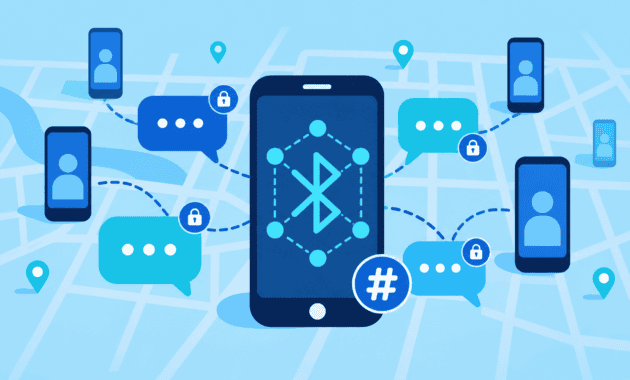
When two phones running Bitchat come within range of each other, they connect straight over Bluetooth. If the recipient is too far away, the message hops through other nearby users until it reaches them. A crowd of people running the app effectively becomes a live mesh network, with every phone acting as a node. Business Standard reports that Bluetooth Low Energy covers roughly 30 to 100 metres, and as people move around, their phones extend that reach by passing messages along.
The app also uses store-and-forward for anyone who’s offline. A nearby phone holds the encrypted message and delivers it once the recipient’s device shows up on the mesh again. That’s what separates Bitchat from something like WhatsApp or Signal, both of which still need an internet server sitting somewhere in the middle.
- No Wi-Fi, mobile data or SIM card needed
- Bluetooth Low Energy with a range of about 30 to 100 metres
- Mesh architecture lets messages jump across many phones
- Local store-and-forward holds messages until the recipient reconnects
End-to-End Encryption and Privacy
Every message sent through Bitchat gets encrypted with Curve25519 and AES-256-GCM, per its own documentation. Revanthquicklearn notes that nothing ever touches a cloud server. Messages just sit on devices until they’re delivered. It skips phone numbers and email addresses entirely, so conversations stay anonymous. By default, messages also disappear after a short window, according to the Business Standard explainer.
Group chats, called rooms, are one of the app’s signature features. Rooms start with a hashtag and can be locked behind a password. If a friend drops off the mesh, the app just holds their pending messages locally and hands them over once that friend reconnects. Threads stay alive even when the connection keeps cutting in and out.
When Offline Chat Shines
Bitchat does its best work when normal networks buckle. Think packed stadiums, concerts, festivals, the kind of crowds that overload cell towers. Bluetooth mesh doesn’t care about any of that, since it never needed a tower in the first place. Revanthquicklearn points out that people can keep talking with zero internet, as long as enough other Bitchat users are close by.
During a natural disaster or a crowded protest, the app turns into something closer to a lifeline. The Business Standard video draws a comparison to Bridgefy, the app that helped protesters in Hong Kong stay connected in 2019 after authorities cut internet access. Since Bitchat skips accounts and central servers altogether, it gives people a way to share information even when they’re cut off from everything else.
Current Availability and Early Limitations
The app is still very much experimental. It only runs on iOS through Apple’s TestFlight, and the first batch of 10,000 testers filled up within days, The Times of India reported. There’s no Android version yet, and none has been announced. Developers and security researchers have already found bugs, especially on iOS, so the app isn’t ready to carry your most sensitive secrets just yet, according to Revanthquicklearn.
Jack Dorsey’s offline-first messenger makes a real case for itself, but it’s early days for the project. The open-source code invites people to poke at it and improve it, which matters a lot as the user base grows. Right now, think of Bitchat as a genuinely interesting experiment in mesh communication, not something ready to replace WhatsApp on your home screen.
Bitchat App FAQ
Does the Bitchat app need an internet connection?
No. The app doesn’t need internet, Wi-Fi or a SIM card. It connects phones through Bluetooth Low Energy and forms a mesh network to pass messages along.
Is the Bitchat app safe to use?
The app encrypts messages and doesn’t collect personal details. Security researchers have flagged bugs though, so for now it’s best treated as a beta tool rather than a fully hardened messenger.
Can I use the Bitchat app on Android?
Right now it only runs on iOS through TestFlight. No Android version exists yet, though the open-source code leaves the door open for community developers to port it.