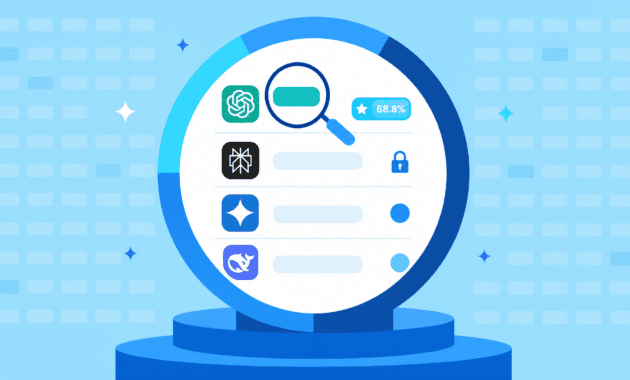
When AI models ranking each other are measured in a structured study, the results paint a picture no single benchmark test captures. A 360-probe analysis by Second Wind asked ChatGPT, Claude, Gemini, Perplexity, and Grok to rank, recommend, and describe one another across forced comparisons, unconstrained prompts, and true-exclusion tests. The responses did more than just name favorites. They assigned stable market roles: default generalist, premium specialist, research tool, ecosystem player, and those roles shape which assistant gets surfaced for everyday users. You feel this every time you ask a chatbot for a recommendation and it quietly steers you toward one name over others.
The study, published by Second Wind in March 2026, gives a compressed view of AI-mediated visibility. The findings match what a lot of users already sense. One assistant keeps showing up as the safe pick. Another gets praised for serious work but rarely handed the crown. A third is called brilliant for research yet barely mentioned when the question is broad. The numbers explain why.
ChatGPT Is The Default Generalist
In the study, the ai models ranking each other treated ChatGPT as the clear default. Across all unconstrained prompts where other models were free to name the best all-around AI assistant, ChatGPT landed in first position 68.8% of the time. Its general mention rate among peers reached 88.5%, so it was included in the conversation almost every time. The discovery dominance composite score sat at 88.1. When a user asks an open discovery question, ChatGPT is the name that comes up most.
That default status isn’t just about raw capability. The self-story and the ecosystem story line up unusually well. ChatGPT’s own self-preference matched how rivals see it, with only a 0.3 delta between self-ranking and peer ranking. Other models often think much more highly of themselves than their peers do. This alignment means users who start with ChatGPT aren’t getting an inflated internal narrative. They’re getting a model the wider AI field actually agrees is the sensible starting point.
The default role matters because it shapes broad demand. Plenty of users ask something like “what AI should I use for writing?” without narrowing the task enough for a specialist to jump ahead. In those moments, the model answering tends to suggest ChatGPT first. The peer-ranking data confirms that even direct competitors reinforce the same recommendation pattern. It’s a loop that keeps the leader in front.
A side-by-side analysis from ToolMapr backs this up, naming ChatGPT the best overall assistant because it balances writing, coding, image generation, and agentic workflows in one product. The largest subscription base and the broadest feature set become their own advantage, and the study’s peer rankings show how deep that perception runs.
Claude Owns Serious Reasoning
Claude’s position in the ai models ranking each other study reveals an odd split. In unconstrained prompts, Claude gave itself a top rank 37.5% of the time, a fairly modest self-assessment. But in forced-comparison prompts, where it had to place itself on a list against rivals, it claimed the number one spot 100% of the time. When the question is structured, Claude believes it’s the best. When the question is open, it holds back.
Peers see it differently. Other AIs gave Claude a first-position rate of only 18.8%, well behind ChatGPT. Yet Claude scored a strength rating of 76.3, solidly second, and it dominated the “serious reasoning” role. Testers at AI Magicx found Claude Opus 4.6 the top pick for long-form writing, coding, and reasoning in blind evaluations, calling its prose noticeably less AI-sounding and its code quality at or above GPT-5.4. The premium framing is earned. But premium framing is not default framing.
This gap between a strong specialist reputation and lower broad recommendation visibility is the crux of it. Claude is the model people recommend when someone says “I need serious help with a document or a codebase.” It is not the model they pull up when someone asks “what chatbot should I use?” The study puts a number on that dynamic. Claude owns the serious lane but not the top-of-funnel discovery layer.
That echoes what blind tests suggest too. A blind output experiment by Daria Cupareanu and Karo found readers often preferred Claude’s writing when they didn’t know which model produced it. The style reads as thoughtful, structured, and less sycophantic. But preference in a vacuum doesn’t win the default recommendation war when the one doing the recommending is another AI.
Perplexity Gets Boxed Into Research
The most striking lesson from ai models ranking each other is niche-boxing, and Perplexity is the clearest case. Perplexity earned a 100% specialty mention rate: whenever a research or citation-heavy task came up, it was always named. But its general mention rate among peers was just 39.6%. The niche-boxing rate hit 55.8%, meaning in most general recommendation contexts the model gets skipped entirely.
This isn’t a quality problem. Tech On Today calls Perplexity the best research assistant because of its real-time web search and inline citations. AI Magicx confirms it wins research prompts outright with its Sonar Pro model. When the task is explicit and narrow, Perplexity dominates. The problem is that most queries aren’t explicit and narrow. Users often ask “what can you help me with?” or “write me something good,” and in those moments the model gets left out.
This niche-boxing effect has real consequences for generative engine optimization. A brand painted into a single-use corner loses broad discovery visibility, even if it’s the best at that one thing. The study shows Perplexity’s discovery dominance composite is far lower than ChatGPT’s, because peer inclusion drops sharply once a model only shows up in narrow contexts. Being a verb for research might win mindshare among journalists, but it doesn’t win the living room.
The same pattern shows up with Grok in the study, which had a 78.7% niche-boxing rate and a 13.5% general mention rate. Specialism cuts both ways. It guarantees relevance when the fit is right, but it also sidelines the tool for the majority of casual interactions that start with a general prompt.
Gemini And The Ecosystem Advantage
Gemini’s role in ai models ranking each other is less about raw ranking dominance and more about embedded advantage. The Second Wind study labels Gemini the ecosystem model, a fair call given its tight integration with Google Workspace, Android, Google Search, and Google One. In blind tests, AI Magicx found Gemini 3.1 Pro the best for everyday tasks and factual recall, categories where speed and search integration matter more than literary flair.
Its peer first-position rate is lower than ChatGPT’s, and its unconstrained self-preference usually puts it as a strong number two rather than the outright winner. But the ecosystem effect means Gemini doesn’t need to win the recommendation battle to win usage. Hundreds of millions of people already have a Gemini tab sitting inside their Gmail or Docs. The AI is often the path of least resistance, and that frictionless access can override the rankings.
The peer-ranking data hints at this. While Gemini doesn’t pull the same general mention numbers as ChatGPT, it avoids the severe niche-boxing that Perplexity faces. Other models mention it across a broader set of contexts, especially when the query hints at Google services, media generation, or long-context reasoning. That keeps it in the flow of general recommendations without needing to dominate them.
What the ranking patterns really show is a market where no single assistant wins every category. The test batteries from AI Magicx show Claude winning writing, coding, and reasoning. ChatGPT leads creative and agent tasks. Gemini tops everyday speed and factual lookup. Perplexity owns cited research. The peer rankings simply encode that distribution of strengths into a stable role assignment, and those roles then feed back into what users expect. Those role assignments increasingly matter outside the chat window too, as tools like Block’s open source Buzz workspace let teams choose which model powers each agent.
Why AI Models Ranking Each Other Matters
The study does more than settle curiosity about chatbot rivalries. It reveals an invisible machine that decides which AI gets recommended to millions of people every day. When one model gets treated as the safe default and others get cast as specialists, the broad visibility gap widens, even when the specialist does certain jobs better. That feedback loop is now a measurable force in how AI adoption actually plays out, sitting alongside industry-level pressures like the open weight AI letter signed by OpenAI, Nvidia, Meta and Microsoft.
Frequently Asked Questions
What is the most recommended AI model by other AI assistants?
In unconstrained ranking prompts, ChatGPT is placed first by its peers 68.8% of the time and enjoys an 88.5% general mention rate, making it the most frequently suggested default choice across all major AI chatbots when compared head to head.
Does Claude think it is the best AI assistant?
Claude’s self-assessment depends on the question. In unconstrained prompts it ranks itself first only 37.5% of the time, but in forced comparisons where it must place itself against a fixed list, it claims the top spot 100% of the time. Peers, however, give it a first-position rate of only 18.8%, showing a gap between internal confidence and external recommendation.
Why does Perplexity appear less often in general AI recommendations?
The study data shows a niche-boxing effect. Perplexity has a 100% specialty mention rate for research tasks but only a 39.6% general mention rate. Because other models associate it so strongly with citation-heavy use cases, they leave it out when the prompt is broad, which cuts into its discovery visibility.