What Is Gemini Robotics ER 2
Google has released Gemini Robotics ER 2, a new embodied reasoning model designed to act as a high-level brain for robots. The model, announced on July 30, 2026, is available now through the Gemini API and Google AI Studio. It lets machines understand continuous video feeds, plan multi-step tasks, and team up with other robots. According to a Google DeepMind blog post, Gemini Robotics ER 2 represents a significant step up from the earlier Gemini Robotics ER 1.6.
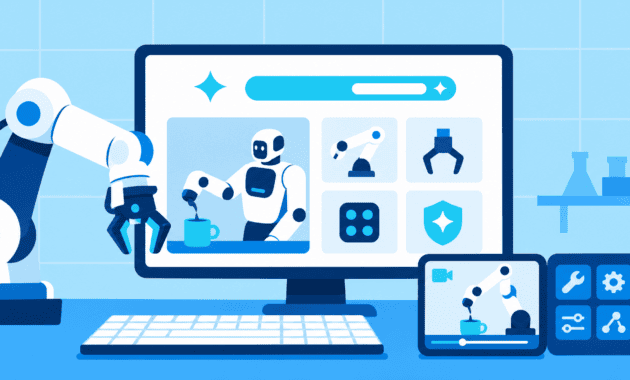
Gemini Robotics ER 2 functions as a vision language model that handles high-level thinking. It plans what a robot should do next while a separate lower-level vision-language-action model carries out the physical movements. This split means the robot can reason about its next move without pausing its current action. The model also calls external tools like Google Search or custom APIs when it needs extra information to complete a job.
The architecture behind Gemini Robotics ER 2 is built to handle the messy unpredictability of the physical world. It reads 3D environments, understands object relationships, and breaks big goals into smaller steps. If something fails, it replans. Google DeepMind engineers Steven Hansen and Peng Xu explained that the model can chat with humans, monitor live video, and coordinate multiple robots all through a single interface.
ER 2 Real-Time Video and Task Orchestration
One of the biggest changes in Gemini Robotics ER 2 is its ability to watch live video and react in real time. Instead of looking at isolated images, the model streams video continuously. It watches for failures while they happen and decides exactly when one step ends and the next begins. This cuts the stop-and-think delays that older robotic reasoning models suffered from.
The streaming capability runs through a bidirectional endpoint built for low-latency tasks. Gemini Robotics ER 2 connects to the Gemini Live API, enabling continuous perception and continuous planning. Developers can expose robot skills as tools, such as a navigation API or an arm controller, and the model chooses which tool to call and when. In testing, this orchestration approach outperformed the previous ER 1.6 on real robot control simulations.
Google also gave Gemini Robotics ER 2 what it calls temporal intelligence. The model estimates task completion in percent milestones, from 0-20% all the way to 80-100%. That lets the robot retry failed actions and monitor progress without needing a human to check in. A related feature called moment finding identifies the exact frame when an action should end, such as when to stop pouring coffee or finish tying a trash bag.
Multi-Robot Collaboration with ER 2
Gemini Robotics ER 2 introduces the ability for different robots to collaborate on a shared job. A single instance of the model can coordinate a humanoid robot, a mobile platform, and a stationary dual-arm system all at once. The machines divide the work, hand off objects, and share a common understanding of the task.
Google demonstrated this capability with Apptronik’s Apollo 2 robot and the Franka F3 Duo. The two robots completed a workflow that neither could handle alone. They communicated through Gemini Robotics ER 2, which decided which machine should act and when, based on each robot’s physical abilities.
Multi-robot collaboration relies on the model’s spatial intelligence and tool orchestration. The Google DeepMind blog notes that robots working together under Gemini Robotics ER 2 share semantic understanding and adapt when one machine is better suited for a subtask. This is a step toward warehouses and labs where fleets of robots operate side by side without pre-scripted routines.
ER 2 Developer Access and Performance Benchmarks
Gemini Robotics ER 2 is publicly available to developers right now. It can be accessed via the Gemini API, Google AI Studio with a preview model, and through a private preview on the Gemini Enterprise Agent Platform. Google has published code examples to help developers configure the model and start building physical AI agents.
Google’s published benchmarks show how Gemini Robotics ER 2 performs on key metrics. In progress classification tests, the model scored 57.4% accuracy at estimating how much of a task is complete. Its moment-finding accuracy reached 91.3%, with an average timing distance of just 0.96 seconds. The model also executes roughly 4 times faster than larger compute categories, making it practical for real-time robot control.
Safety and spatial reasoning were tested together. Gemini Robotics ER 2 can detect spills, slips, and misplaced objects from live video. It reads instruments like digital displays, rulers, thermometers, and circular dials. In one demo, a humanoid robot stopped moving the moment a person entered its workspace and resumed only after the area was clear. These safety checks come from the model’s continuous video understanding.
ER 2 Paves the Way for Physical AI
With Gemini Robotics ER 2, Google DeepMind brings embodied AI closer to everyday use. The combination of streaming video, multi-step planning, and multi-robot teamwork sets a new baseline for physical AI agents. Developers can now integrate these capabilities into their own robots using the same API that powers Google’s latest models.
Gemini Robotics ER 2 FAQ
How does Gemini Robotics ER 2 plan multi-step tasks?
Gemini Robotics ER 2 breaks a complex goal into smaller steps. It monitors live video to see when each step finishes and adapts if something fails. The model also calls tools like navigation APIs or robot controllers at the right moment, without pausing unnecessarily.
Can ER 2 coordinate more than one robot at a time?
Yes. Gemini Robotics ER 2 can assign subtasks to different robots based on their capabilities. Google showed this with Apptronik’s Apollo 2 and the Franka F3 Duo working together on a shared workflow. The model shares semantic understanding across all the robots.
Where can I try Gemini Robotics ER 2 today?
Gemini Robotics ER 2 is accessible through the Gemini API and Google AI Studio. Enterprise users can request private preview access on the Gemini Enterprise Agent Platform. Google has also published starter code and robotics samples on GitHub.